

Why G-15 (G-30) Glass-Polyimide Is the Preferred Material for Solid Rocket Motors & Aerospace
When extreme thermal environments, structural loads, and mission-critical reliability converge, there is one thermoset composite that engineers reach for: glass-reinforced polyimide laminate.
What Is G-15 (G-30) Glass-Polyimide Laminate?
G-15 (G-30) is a NEMA LI-1 grade designation for glass fabric reinforced polyimide laminates. Bound by a polyimide resin system — not the familiar epoxy found in FR4 or G10/G11 — which is the defining distinction that makes this material class so valuable to aerospace and defense engineers.
Polyimide resins are formed through an imidization reaction that produces exceptionally stable aromatic ring structures. These ring structures resist thermal degradation far beyond the limits of epoxy systems, enabling the material to retain its mechanical properties at temperatures that would cause conventional thermoset composites to soften, outgas, or delaminate.
The Thermal Performance Case: Heat That Would Destroy Alternatives
Solid rocket motors present one of the most demanding thermal environments in engineering. Combustion chamber walls, nozzle throats, ablative liner supports and thrust vector control components are exposed simultaneously to extreme heat, mechanical stress, and chemical aggression from combustion byproducts.
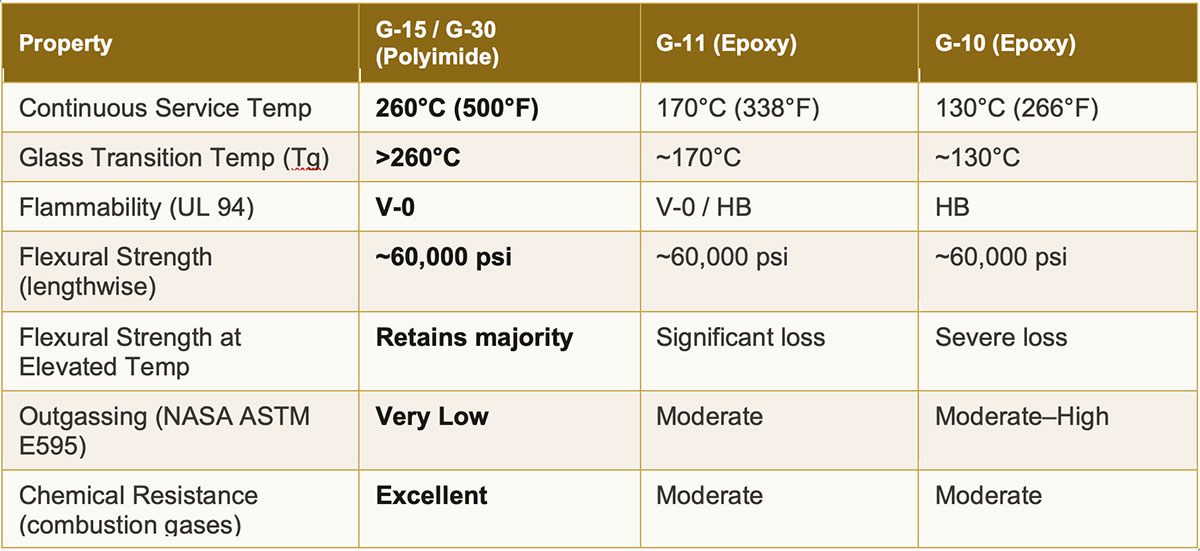
G-15/G-30 polyimide laminates are rated for continuous service at 260°C (500°F), with short-term peak exposure survivability exceeding 300°C. This is not simply a number on a datasheet — it reflects a fundamental resin chemistry that remains cross-linked and dimensionally stable where epoxy-based materials (such as G-10 or G-11) begin to soften, lose interlaminar shear strength, and ultimately fail.
Material Property Comparison
Key Properties That Define Its Aerospace Role
Beyond raw temperature ratings, G-15/G-30 delivers a holistic property profile that makes it uniquely suited to aerospace and propulsion applications. These properties work together as an integrated system:
- Dimensional Stability Under Thermal Cycling — Polyimide resin systems maintain their geometric tolerances through repeated heat cycles, which is critical for sealing interfaces, bearing housings, and structural inserts exposed to rapid and extreme thermal cycling in solid rocket motors.
- Low Outgassing for Vacuum and Space Environments — G-15/G-30 meets NASA low-outgassing specifications (ASTM E595), making it suitable for satellite structures, spacecraft interiors, and launch vehicle components where volatile contamination of optics or sensors is unacceptable.
- Excellent Electrical Insulation at Elevated Temperatures — Many rocket motor sub-assemblies require concurrent structural and electrical insulation performance. G-15/G-30 maintains volume resistivity and dielectric properties at operating temperatures where epoxy laminates fail electrically.
- Flame and Arc Resistance (UL 94 V-0) — In the event of a thermal excursion, V-0 rated polyimide laminate self-extinguishes and does not contribute propagating flame — a safety-critical characteristic for propellant-adjacent structural components.
- Machinability to Tight Aerospace Tolerances — G-15/G-30 can be precision-machined to ±0.005" or tighter, enabling complex geometries — bores, slots, radii, counterbores — required in propulsion hardware. Franklin Lamitex’s precision CNC fabrication capabilities are directly optimized for this material.
Common Aerospace Applications
G-15/G-30 glass-polyimide laminate is specified across a wide range of solid rocket motor and broader aerospace applications where the combination of thermal, structural, and electrical performance is non-negotiable.

Fabrication Considerations: Where Material Meets Precision
Specifying G-15/G-30 is one thing. Translating a raw laminate sheet or rod into a flight-qualified component is another matter entirely. Polyimide laminates present distinct machining characteristics compared to epoxy-based grades — and working with an experienced fabricator is not optional, it is mission-critical.
The abrasive nature of the glass reinforcement demands proper tooling selection, feeds, and speeds to avoid delamination, fiber pullout, or subsurface damage that may not be visible but can affect structural integrity. Franklin Lamitex has decades of experience working with G-15/G-30 across complex geometries: precision bores, thin walls, sharp radii, slotted sections, and compound contours.
Franklin Lamitex supplies G-15/G-30 in sheet, rod, and tube forms, and provides precision-machined components to customer drawings with full material certification, dimensional inspection reports, and AS9100-backed quality documentation packages.
Ready to Specify G-15/G-30 for Your Application?
Franklin Lamitex provides material, fabrication, and engineering support for aerospace and defense programs. Contact our technical team to discuss your requirements.
Contact: info@lamitex.com · 302-652-3621 · www.lamitex.com