

G11 vs. FR5 - NEMA Grade Composites — Technical Comparison & Selection Guide
NEMA grades G11 and FR5 are both woven-fiberglass-reinforced epoxy laminates built for demanding electrical and structural applications. They share the same glass fabric backbone and similar epoxy chemistry — yet the distinction between them matters enormously for engineers specifying materials in elevated-temperature, high-voltage, or flame-critical environments.
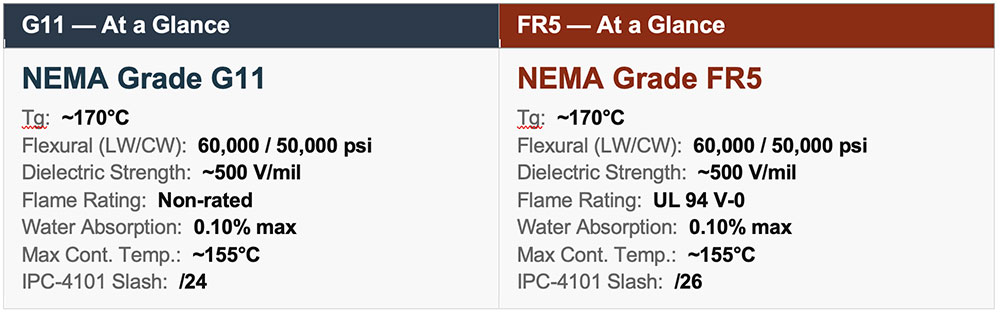
Key Properties at a Glance
Origins & Standards
Both grades are defined under the NEMA LI-1 standard for industrial laminates, with parallel designations in IPC-4101 (slash sheets /24 and /26 respectively). They belong to the same family of woven E-glass / epoxy composites and were developed as upgrades to the baseline FR-4/G-10 system — offering improved thermal performance where standard laminates begin to soften and lose dimensional stability.
The core distinction comes down to flame retardancy. FR5 is the flame-retardant version of G11, just as FR-4 is the flame-retardant counterpart to G-10. The mechanical and thermal backbone of both grades is otherwise nearly identical.
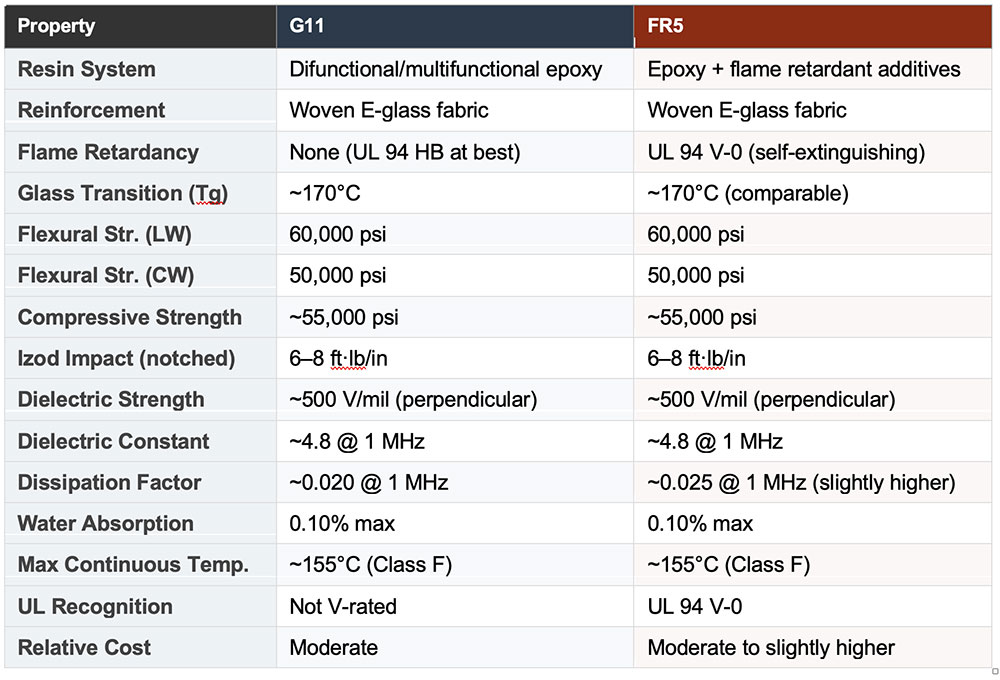
Side-by-Side Comparison
The Flame Retardancy Question
The single most important differentiator is whether the application requires a UL 94 flame rating. UL 94 V-0 means the material self-extinguishes within 10 seconds after a flame is removed, and does not drip burning particles. G11 carries no such certification — it may char and sustain combustion under certain conditions.
Flame retardancy in FR5 is typically achieved through brominated epoxy resins (TBBPA as a reactive flame retardant monomer) or, in newer halogen-free formulations, through phosphorus-nitrogen synergistic systems. The trade-off is subtle: the flame retardant chemistry introduces a modest increase in the dissipation factor (loss tangent), marginally affecting RF signal integrity — rarely a concern at power frequencies, but worth noting for high-frequency RF or precision analog designs.
G11 and FR5 share the same structural skeleton. What separates them is entirely about what happens when they meet a flame — and whether that matters for your application.
Thermal Performance: More Similar Than Different
Both grades target a Tg of approximately 170°C, placing them well above the standard FR-4 range of 130–145°C. This elevated glass transition temperature means the epoxy matrix remains dimensionally stable, mechanically stiff, and electrically reliable to much higher operating temperatures than commodity PCB laminates.
In continuous service, both grades perform well to 155°C, making them suitable for Class F (155°C) and approaching Class H (180°C) electrical insulation requirements per IEC 60085. For applications pushing beyond 180–200°C continuous service, polyimide or bismaleimide-triazine (BT) laminates are the appropriate step up.
Machining & Fabrication
G11 and FR5 behave nearly identically during machining. Both are abrasive on cutting tools due to the woven glass content, requiring carbide or diamond-tipped tooling for high-volume operations. Both exhibit good drill registration, low delamination tendency, and can be routed, punched (when warmed), sawn, or waterjet cut.
Relevant Fabrication Notes
Neither grade should be machined dry in enclosed environments without ventilation — the glass fiber dust is a respiratory hazard and the epoxy particulate from FR5 may contain halogenated compounds. Wet machining or appropriate dust extraction is standard practice. Both grades bond well with standard epoxy adhesives and can be laminated, drilled, and plated using conventional PCB processing chemistry.
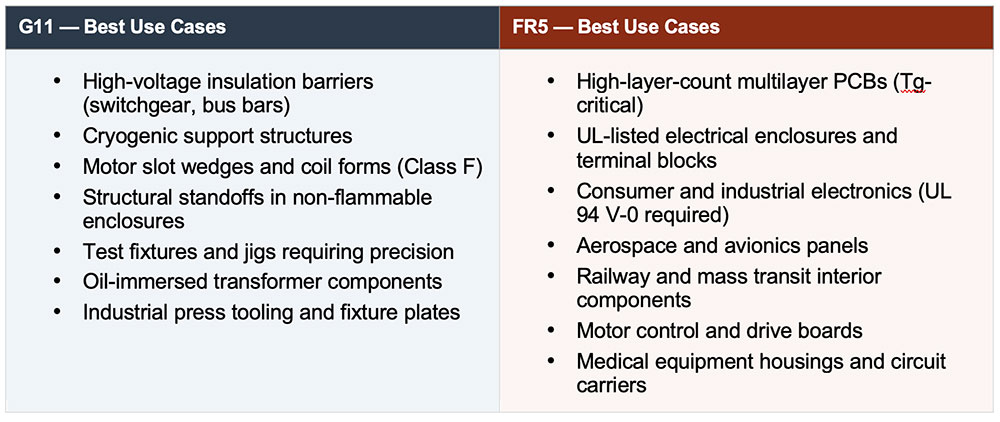
Best Use Cases
When G11 is Preferred
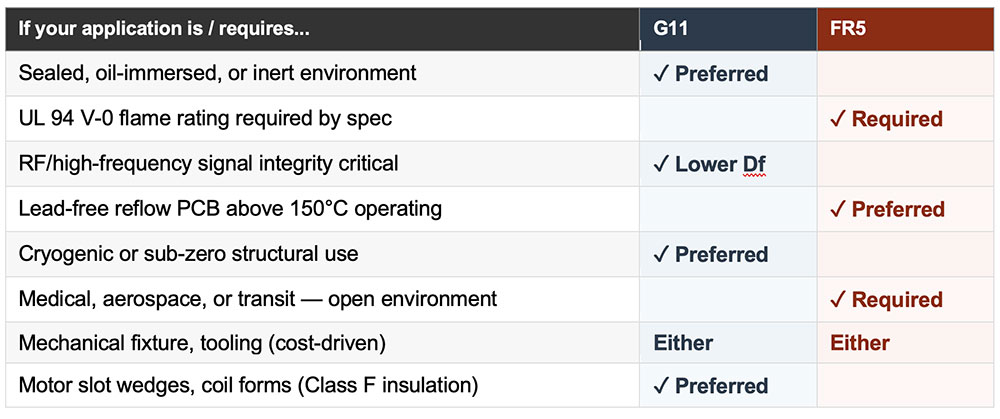
G11 is the material of choice when flame retardancy is not a regulatory or safety requirement — and when avoiding FR additives is beneficial. Applications in sealed, non-flammable environments (oil-immersed, inert-gas-filled, or cryogenic) have no need to pay the slight cost and dissipation-factor premium of FR5.
High-voltage structural insulation in switchgear, transformer components, and motor insulation systems frequently specify G11 precisely because the FR chemistry adds nothing of value in those environments. Cryogenic applications — superconducting magnet support structures, liquid nitrogen or liquid helium service — also favor G11 for its well-characterized thermal contraction behavior.
When FR5 is Required
FR5 is mandatory anywhere UL 94 V-0 flame rating is specified by code, customer requirement, or safety certification. This encompasses the vast majority of commercial and industrial electronic products sold in North America and Europe, where IPC-4101 /26 or equivalent flame performance is a baseline requirement.
For multilayer PCB stackups requiring post-lamination dimensional stability at elevated reflow temperatures (lead-free solder processes peak around 260°C), FR5 provides the high-Tg foundation needed to minimize z-axis expansion, via barrel stress, and delamination risk.
Selection Guide
A Note on Modern Halogen-Free Variants
Franklin Lamitex offers a specially formulated halogen-free FR5 material. Due to the specialized formulation, this material has increased electrical resistance and can be a direct replacement for NEMA grade G5 and G9. Environmental regulations including the EU RoHS directive and REACH have driven significant adoption of halogen-free FR5 variants. These replace brominated flame retardants with phosphorus-nitrogen synergistic systems. The flame performance (UL 94 V-0) is maintained, but the halogen-free chemistry can exhibit slightly different moisture absorption characteristics. Engineers specifying halogen-free FR5 should verify Tg and Df values against the specific formulation datasheet rather than assuming identical performance to brominated FR5.