

Understanding Convolute, Spiral and Filament Wound Tube: What the Construction Changes
Convolute, spiral and filament winding describe how a tube's wall is built, not what it is made of. That distinction decides strength direction, seam behavior, machinability and cost — often more than the resin system does.
At a glance
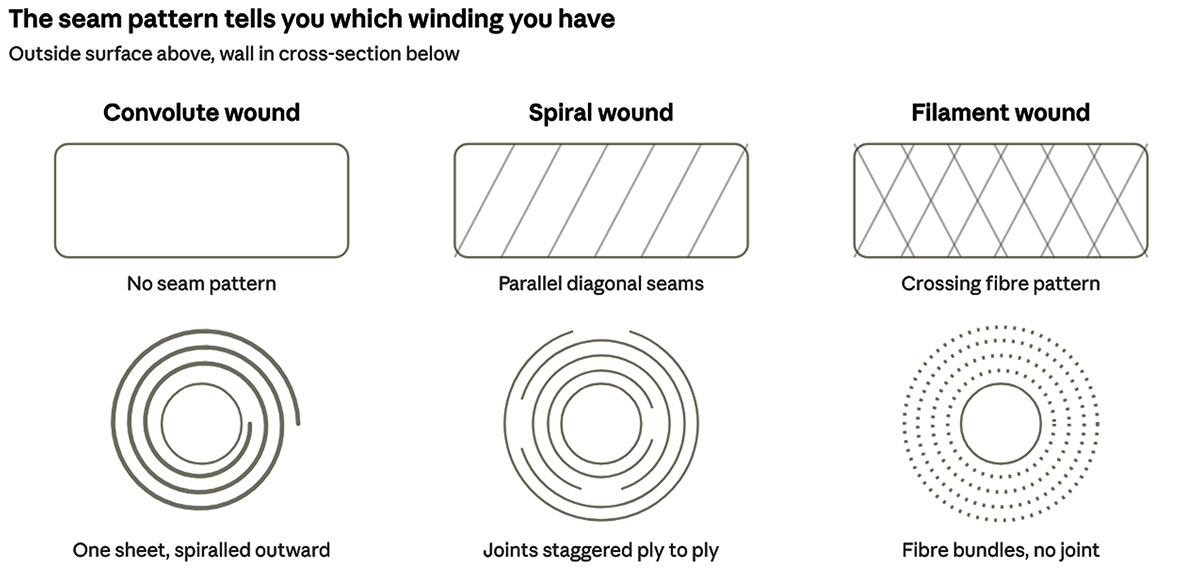
The outside surface is the quickest tell. A plain pressed surface is convolute. Parallel diagonal lines are spiral. Crossing diagonals are filament. The inside diameter is formed against the mandrel in all three.
Convolute wound: one continuous sheet
A convolute wound tube is a single continuous sheet of resin-impregnated substrate wrapped around a mandrel in overlapping turns, then cured under heat and pressure. Think of rolling a carpet. One piece of material, many turns, one wall.
The reinforcement is a sheet good: kraft or cotton paper, cotton fabric, or woven glass cloth, impregnated with resin and advanced to a tacky B-stage before it reaches the mandrel. Because the sheet never stops, the finished wall carries no helical seam along its length. Cut it and you see a spiral of continuous material rather than a stack of separate plies.
That provides four things engineers tend to care about:
- Concentricity. The mandrel sets the ID and the wrap builds outward evenly, so wall thickness stays consistent around the circumference.
- Balanced in-plane properties. A woven substrate carries load in both directions of the weave, so the tube behaves closer to isotropic in the plane of the fabric than a wound-fibre tube does.
- Machinability. The fabric or paper supports the cutting edge, which is why convolute tube turns, bores and threads cleanly instead of fraying at the cut.
- Dielectric performance. Continuous insulating substrate with no seam path through the wall is a good starting point for anything standing off voltage.
This is the construction behind most NEMA grade industrial laminate tube — G-10, G-11, FR-4, LE, CE and the various other grades. It is the default where the tube is an electrical insulator, a precision machined component, or both.
Spiral wound: narrow plies, staggered seams
Spiral winding feeds narrower strips or tapes onto the mandrel at a helix angle rather than wrapping one wide sheet straight around it. Each ply overlaps the one before, and successive plies are laid in opposing directions so their joints stagger through the wall instead of stacking on top of each other.
Look at the outside of a spiral wound tube and you can usually read the process off it: parallel diagonal seam lines running the length of the part.
The economics are the reason it exists. Because the material is fed continuously at an angle, spiral winding handles long lengths and large diameters that a sheet wrap struggles with, and it does so at lower cost in those sizes.
The trade-off is that seam geometry becomes part of the engineering conversation rather than a detail you can ignore. Where the joints fall through the wall matters to anything carrying real load, and it matters to deep machining — a bore or a cross-hole that lands on a joint line behaves differently from one that does not. On a structural member it is worth a conversation before the print is released.
Common applications include ducting, protective sleeving, large-diameter structural tube, and cost-sensitive tubing where the wall is doing a containing job rather than a load-bearing one.
Filament wound: continuous roving at engineered angles
Filament winding uses no sheet and no fabric. Continuous reinforcement roving — glass, carbon or aramid — is drawn through a resin bath and laid onto a rotating mandrel at wind angles the engineer chooses deliberately. The reinforcement architecture is not something the substrate brings with it. It is designed.
This is worth understanding before specifying a filament wound tube. Windings laid close to perpendicular to the tube axis carry hoop stress, which is what resists internal pressure. Windings laid at shallow angles to the axis carry tension, compression and bending. A tube wound for one is not automatically good at the other, and the published strength of a filament wound tube means little until you know which direction it was wound to carry.
Done well, the result is fibre-dominated and gives the highest strength-to-weight of the three constructions.
Three costs come with it:
- Surface. The as-wound outside is rougher than a pressed laminate and often needs a finishing operation if dimensions or appearance matter.
- Machining. Cutting across the fibre direction invites pullout and delamination at edges and holes. Parts that need significant machining sometimes get a fabric or resin-rich overwrap purely to give the tool something to cut.
- Setup. Tooling and wind programming are real up-front costs that only pay back at volume, or when the performance requirement leaves no alternative.
It is where pressure vessels, drive shafts, hydraulic cylinders and high-load structural members come from.
Side by side
This table compares constructions, not grades. Mechanical and electrical values for any specific NEMA grade should be read off that grade's datasheet rather than inferred from the winding method.
What all three share
The differences get the attention, but the common ground is most of why any of them end up on a print instead of a metal part.
All three are thermosets. The cure is a one-way chemical reaction, so the finished wall will not re-soften and flow the way a thermoplastic does when it gets hot. That is the property that puts these materials in electrical and elevated-temperature service in the first place.
All three are built on a mandrel. The inside diameter is the controlled surface, formed against tooling, and the outside is where the machining allowance lives. If your print calls out a tight OD, you are machining it — on any of the three.
All three can run similar resin systems: epoxy, phenolic, polyester, melamine, silicone. This is the single most common source of mis-specification in this material family. Construction and resin chemistry are separate decisions, and a property someone attributes to "filament wound" or "convolute" is often really a property of the epoxy or the phenolic underneath it. Worth separating the two before you write the callout.
And all three buy the same fundamental trade against metal: dielectric strength where a metal would conduct, corrosion resistance where a metal would pit, and a fraction of the weight. Those three reasons cover most of the tube we ship.
Which belongs on your print
There is no best construction, only a best fit. These are the questions that actually decide it, in the order they tend to matter.
- Is the tube insulating, carrying load, or both? Pure insulation points hard at convolute. Pure load points at filament. Both at once is where the conversation gets interesting, and where a wrong pick is expensive.
- Which direction does the load run? Internal pressure is hoop stress. Bending and column loading are not. If you cannot answer this, a filament wound tube cannot be specified properly, because the wind angle is the answer.
- How much material are you removing, and where? Heavy machining, threads, cross-holes and close-tolerance bores all favour a substrate that supports the cutting edge. This is where convolute tube earns its place in a machine shop.
- What diameter and length? Large and long pushes toward spiral for cost reasons. Small and precise pushes the other way.
- What is the service environment? Temperature, moisture, chemical exposure and voltage are resin questions more than construction questions — but they narrow which grades are even candidates.
- What tolerance, and on which surface? A tight ID is formed. A tight OD is machined. Knowing which one is critical changes the quote on every construction here.
If you can answer one through four, most applications resolve themselves. If you cannot answer two, start there.